




Your property ranks on Google. Your paid campaigns are running. Traffic is coming to the website.
So your community must be visible, right?
Not necessarily.
One of the biggest shifts happening in multifamily search is that ranking and visibility are no longer the same thing. A property can perform well for a handful of keywords and still be absent from other places renters are using to research their next apartment.
A prospective renter might start with Google, jump into Maps, browse reviews, ask ChatGPT or another AI-powered search tool for recommendations, compare a few communities, and eventually search for a specific property by name. Another renter might take a completely different path.
That creates a challenge for multifamily marketers. Your community may be visible in the places you’re measuring while remaining nearly invisible in the places you’re not.
We call that the Visibility Gap.
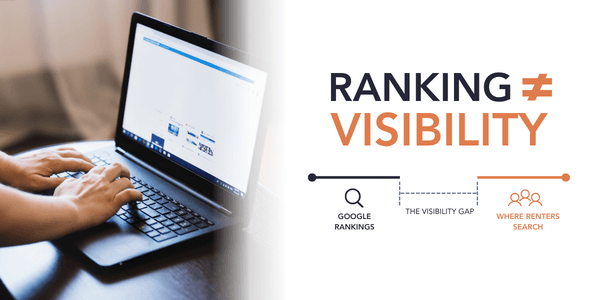
It’s the space between where your property shows up today and everywhere renters may be looking for it.
And as apartment discovery becomes more fragmented, that gap matters more than ever.
What Is the Visibility Gap?
Imagine looking at your monthly marketing report and seeing strong paid impressions, a few important keywords on page one, and healthy website traffic. On paper, visibility looks pretty good.
Now zoom out.
How does the community perform in local search? Does it consistently appear in Google Maps? Is its Google Business Profile complete and accurate? How does its visibility compare with nearby competitors? Does the property appear when renters ask AI-powered search tools questions about apartments in the area?
And perhaps most importantly, do search engines have enough consistent information across the web to confidently understand who the property is, where it’s located, and what it offers?
That broader view can reveal a very different picture.
The Visibility Gap isn’t necessarily a sign that your marketing is failing. It’s a sign that the renter discovery journey has become larger than the channels most teams have historically measured.
A community may have excellent paid visibility but limited organic presence. Another may rank for broad apartment keywords while barely appearing for more specific renter questions. A property may have a strong website but inconsistent listings and a neglected Google Business Profile.
In each case, the property is visible somewhere. It just isn’t visible everywhere it needs to be.
That distinction is becoming increasingly important because the goal of modern search marketing is no longer simply to earn a high-ranking position. It’s to make your community easy to discover throughout the renter’s search journey.
The New Renter Journey
There was a time when the renter search journey was pretty easy to visualize: open Google, search “apartments near me,” click a few listings, and visit some property websites.
That journey still happens. It’s just not the only one anymore.
Today’s search landscape stretches across several interconnected discovery surfaces, each playing a different role in how renters find, evaluate, and eventually choose a community.
Traditional Google Search
Traditional organic search remains an important part of apartment discovery. Renters still search for communities, neighborhoods, amenities, floor plans, pricing, pet policies, commute information, and countless variations in between.
But even within Google, the experience has changed. Organic blue links now compete for attention with Maps, local results, paid ads, AI-generated answers, featured content, and other search features.
Ranking well still matters. It just doesn’t guarantee that you own the entire search experience.
Maps and Local Search
Multifamily search is inherently local. Renters care about where a community is located, what’s nearby, how it’s reviewed, and whether it fits the geographic area they’re considering.
That makes Google Maps and local search especially important for apartment communities. A renter can discover a property, view photos, read reviews, get directions, compare nearby communities, and form an initial opinion without ever visiting the property’s homepage.
If your Google Business Profile is incomplete, inaccurate, or less competitive than nearby properties, your website rankings won’t necessarily tell you that you have a local visibility problem.
That’s the Visibility Gap in action.
AI-Powered Search
Then there’s the newest layer of the renter journey.
Instead of typing a few keywords and scrolling through links, renters can increasingly ask complete questions like:
- “What are some pet-friendly apartment communities near downtown Austin with coworking space?”
- “Which apartments near this office have good reviews and covered parking?”
- “What are the best apartment options in this neighborhood for someone who works from home?”
AI-powered search experiences can synthesize information and surface recommendations rather than simply returning a traditional ranked list.
That changes the visibility question. Instead of only asking “Where do we rank?” multifamily marketers increasingly need to ask “Are we being included at all?”
That’s one reason newer visibility measurements such as AI Share of Voice can be useful. Rather than focusing on a single ranking, they can help marketers understand how often a property appears in AI-powered search compared with nearby competitors and where visibility gaps may be starting to emerge.
Reviews, Listings, and the Rest of the Web
Renters also gather information outside traditional search results. They read reviews, visit directories, encounter local listings, and may find a property mentioned on another website before searching for it later.
Those signals do more than help renters make decisions. They also contribute to the broader digital picture surrounding a property.
Your website is an important source of information about your community, but it isn’t the only one. When those sources are inconsistent, incomplete, or missing altogether, the Visibility Gap gets wider.
What’s Creating the Gap?
The Visibility Gap usually isn’t caused by one dramatic SEO mistake.
More often, it’s the result of several smaller weaknesses that accumulate over time. A little thin content here, an outdated listing there, a neglected local presence somewhere else. Individually, they may not look like major problems. Together, they can leave some pretty meaningful gaps.
A Website Built for Rankings, Not Renter Questions
A property website may be optimized around a small group of broad keywords without providing enough useful information about what renters actually want to know.
Neighborhood details may be thin, amenity information may be vague, floor plan pages may offer little context, and Frequently Asked Questions (FAQs) may not exist at all.
That becomes a bigger problem as search behavior gets more specific and conversational. Strong search visibility requires content that helps both renters and search systems understand what makes a property relevant to a particular search.
The more generic the information, the fewer opportunities your community has to match specific renter intent.
Inconsistent Local Signals
Another common source of the gap sits outside the website.
Property information may differ between Google Business Profile, directories, listings, and other sources. Reviews may go unmanaged, business profiles may contain outdated information, and local citations may be incomplete or inconsistent.
Each issue may seem relatively small on its own, but together, they weaken the property’s local presence.
A search engine trying to understand your community shouldn’t have to play detective. The clearer and more consistent your property’s identity is across the web, the stronger the foundation for local discoverability.
Limited Authority
Visibility also depends on whether your property has built enough digital authority to compete.
That can include relevant backlinks, citations, reviews, useful content, consistent local information, and other signals that reinforce the credibility and relevance of the community.
Authority takes time to build, which is part of what makes it easy to overlook. Paid media can generate visibility almost immediately. Authority works differently.
But over time, a stronger digital presence gives your property more opportunities to be discovered without having to purchase every interaction.
Measuring Too Narrowly
Sometimes the Visibility Gap exists partly because marketers simply can’t see it.
If your SEO dashboard focuses exclusively on rankings and organic sessions, strong performance in those metrics may create the impression that visibility is covered. But a keyword ranking report can’t tell you how your property compares with competitors in AI search, just as organic traffic alone can’t tell you whether your local presence is strong.
Paid impressions don’t tell you what happens when a renter searches for your community later, either.
The measurement strategy needs to expand along with the search landscape. Google rankings are still part of the story, but they’re no longer the entire story.
That same principle sits at the center of Digible’s Search Visibility Report, which looks beyond rankings to AI Share of Voice, competitive positioning, local search performance, and overall visibility.
The Visibility Gap Can Become a Marketing Efficiency Gap
There’s another reason the Visibility Gap matters beyond SEO reporting.
When organic visibility is weak, other marketing channels often have to work harder.
If renters aren’t discovering your property naturally through search, Maps, local results, or other organic touchpoints, paid media may have to create more of those introductions.
That doesn’t make paid media the problem. Paid search, social, Performance Max, display, and other channels all have important roles in a multifamily marketing strategy.
The problem is asking paid media to do all the work.
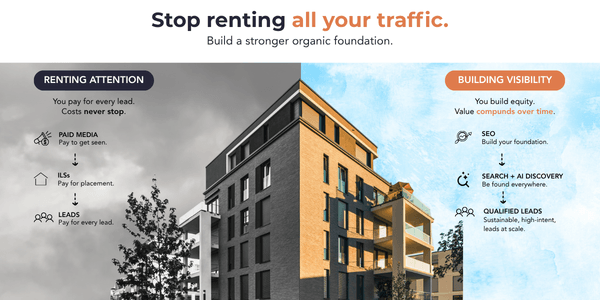
A stronger organic presence gives renters more opportunities to encounter your property before, during, and after a paid interaction. Someone may see an ad today, search your property tomorrow, read reviews later in the week, and return organically when they’re ready to tour.
The channels are connected because the renter journey is connected.
The wider the Visibility Gap, the more likely your marketing strategy is relying on paid channels to compensate for places where your community is difficult to discover organically.
Closing that gap doesn’t mean replacing paid media. It means building a stronger foundation underneath it.
Closing the Visibility Gap
Closing the Visibility Gap starts by changing the objective.
Instead of optimizing for a handful of rankings, the goal becomes building a search presence that works across the different places renters discover apartments.
That still begins with SEO, but it doesn’t end there.
Strengthen the SEO Foundation
Your website needs to be technically healthy, easy to crawl, well structured, and genuinely useful to renters.
That means providing clear property information, relevant page content, optimized metadata, strong internal structure, useful neighborhood information, and answers to specific renter questions.
Traditional SEO remains the foundation because search systems still need accessible, understandable information about your property. The stronger that foundation is, the more you have to build on across the rest of the search ecosystem.
Build the Off-Site Presence Around It
Your website then needs reinforcement from the rest of your digital footprint.
Your Google Business Profile should be accurate and actively maintained, local citations should be consistent, reviews should be monitored, and listings should reinforce the same property information. Relevant backlinks and mentions can also help strengthen authority.
Together, those off-site signals give renters and search systems a more complete and consistent view of your property.
Add GEO to the Strategy
Generative Engine Optimization (GEO) extends that foundation into AI-powered search.
It isn’t a replacement for SEO. It’s the next layer.
GEO focuses on making your property’s information clearer, more structured, and easier for AI-powered search experiences to interpret within the broader digital ecosystem. That can include structured data, entity signals, useful conversational content, consistent business information, authority, and reputation.
In other words, much of the work required to improve AI visibility starts with the same thing good SEO has always required: make your property clear, useful, credible, and easy to understand.
What’s changing is the number of places where those signals can influence discovery.
Measure Visibility as a Whole
Finally, you need a way to actually see the gap.
Instead of evaluating each channel in isolation, look at the property across traditional search, AI-powered search, local visibility, and competitive positioning.
Where are competitors showing up that you aren’t? Which search surfaces are strongest, and which need attention? Is your community consistently represented across the web? Are renters able to discover you through multiple paths, or does most of your visibility depend on one or two channels?
Those questions are much closer to how renters actually search. More importantly, they give marketers something rankings alone can’t: a map of where the opportunities are.
Visibility Is Bigger Than a Ranking
For multifamily marketers, the biggest mistake may no longer be ranking poorly.
It may be assuming that ranking well means your visibility problem is solved.
Search has expanded beyond one results page, and renters now move between traditional search, Maps, local listings, reviews, property websites, paid media, and increasingly, AI-powered search experiences.
Your community doesn’t need to dominate every surface every time. But you should understand where it’s showing up, where competitors are gaining ground, and where meaningful gaps exist.
Because once you can see the Visibility Gap, you can start closing it.
See How Visible Your Property Really Is
If Google rankings are only part of the picture, the next step is understanding how your property performs across the rest of the search landscape.
Digible’s Free Search Visibility Report gives you a personalized look at your property’s AI Share of Voice, Search Visibility Score, competitive positioning, local search performance, and top opportunities to strengthen visibility.
Find the gaps before your renters do.