




**This information reflects what is publicly known approximately one week after OpenAI’s initial announcement regarding ChatGPT ads. Details are evolving, and many aspects of the product, buying model, targeting, and measurement remain unconfirmed. Digible will continue monitoring updates closely and will share guidance as more information becomes available, including our recommendations for clients and insights specific to multifamily audiences as the testing progresses.
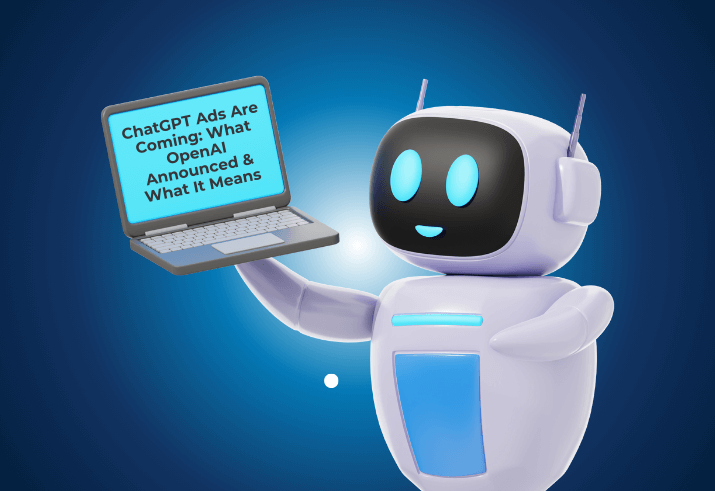
OpenAI has officially announced it will begin testing ads in ChatGPT in the U.S. in the coming weeks. This is not a full launch, not global, and not a sudden flood of banners, but it is a meaningful shift in how AI products may be funded and scaled going forward.
If you care about how people discover information, evaluate options, and make decisions online—which we do being a digital marketing agency—this announcement matters.
Below is what we know, what this is not, and the big open questions that will determine whether ChatGPT ads become a serious new channel or a short-lived experiment.
What We Know So Far (Confirmed by OpenAI)
Who Will See Ads
- Logged-in U.S. adults (18+)
- ChatGPT Free and ChatGPT Go users only (ChatGPT Go is a newly launched tier that OpenAI says is rolling out broadly)
- No ads for Plus, Pro, Business, or Enterprise users
In other words: ads are positioned as a tradeoff for lower-cost access, not something everyone is forced into.
Where Ads Will Appear
Ads will appear at the bottom of answers. Clearly labeled and visually separated from the organic response
This is an important distinction. Ads are adjacent to answers — not embedded within them. OpenAI is being very explicit about keeping the model’s response itself non-sponsored.
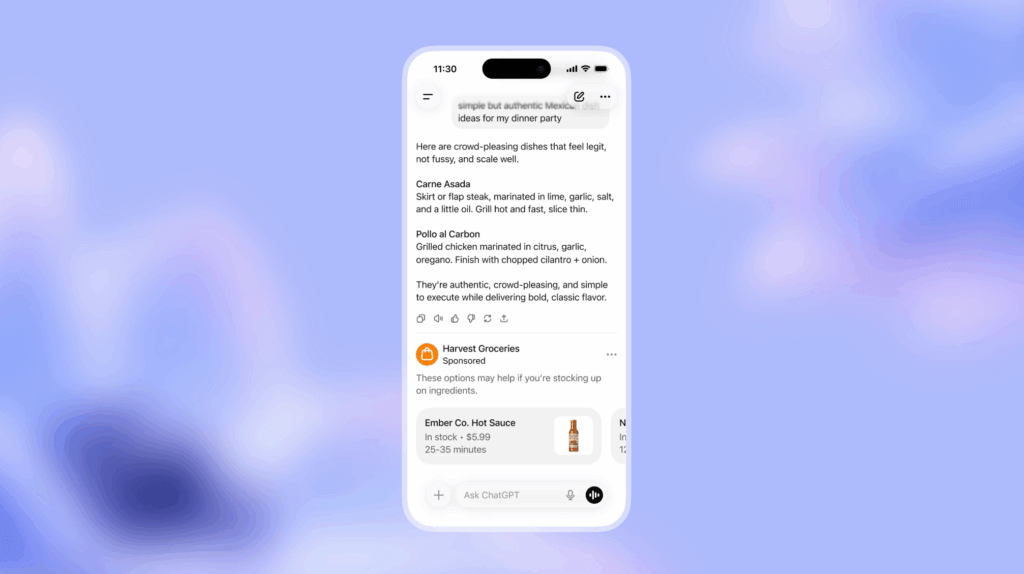
How Ads Are Chosen
- The initial approach is described as contextual
- Ads appear only when there is a relevant sponsored product or service based on the current conversation
This is not classic keyword targeting. It’s intent-based placement tied to what the user is actively asking. Which, if done well, could be far more revealing than a search query.
Trust, Privacy, and User Control
OpenAI is clearly trying to overcorrect here and that’s probably smart.
Confirmed positioning includes:
- Responses must remain “objectively useful,” not driven by advertising
- Conversations are not sold to advertisers
- Users can see why they’re getting an ad
- Users can dismiss ads and provide feedback
- Sensitive categories (health, politics, etc.) are excluded
This is OpenAI planting a flag: ads fund access, not influence answers. Whether that line holds over time is the real test.
What This Is Not
Let’s clear up a few misconceptions early:
- Not ads inside answers – The response itself is not sponsored or altered.
- Not constant ad exposure – Ads appear only when there’s a relevant sponsored product or service.
- Not a full rollout – This is a limited U.S. test, explicitly framed as experimentation — not general availability.
If you’re expecting a Google-style ad ecosystem tomorrow, relax. We’re not there.
What We Still Don’t Know (And These Are the Big Ones)
OpenAI has not shared details on several things that will determine how usable this channel actually is:
Buying & Pricing: It remains unclear whether ChatGPT ads will be auction-based, offered through fixed placements or sponsorship models, or connected to an existing ad exchange.
Targeting Mechanics: Open questions remain around how “contextual” targeting will work in practice, whether targeting relies solely on the current conversation or incorporates additional signals by default, and how opt-out functionality is implemented at a technical level.
Measurement & Attribution: OpenAI has not confirmed what types of conversions will be supported, whether on-platform attribution or APIs will be available, or how tracking will function across cookies, device IDs, or logged-in user identities.
Creative Formats: Beyond being clearly labeled and placed at the bottom of responses, it is still unknown whether ads will be limited to text or expand to interactive formats, rich media, or lead-generation experiences.
Wired hints at possible interactive formats down the line, but nothing is committed.
Advertiser Policies
- We know sensitive categories are excluded
- We do not have a full policy framework comparable to Google or Meta
Until these details are public, any performance claims are speculation.
Why This Matters (Even If You’re Not Advertising Yet)
AI-driven discovery is already reshaping how people ask questions and form opinions. ChatGPT ads aren’t about replacing search overnight, they’re about meeting intent earlier, before users ever think in keywords.
This test is OpenAI signaling that:
- AI access needs sustainable funding
- Advertising can exist without poisoning the product
- Discovery is shifting from “searching” to “asking”
Whether this becomes a meaningful channel depends on execution, transparency, and results — not hype.
For now, this is a smart, cautious first step. The real story will be in the data. And yes, we’ll be watching closely.