




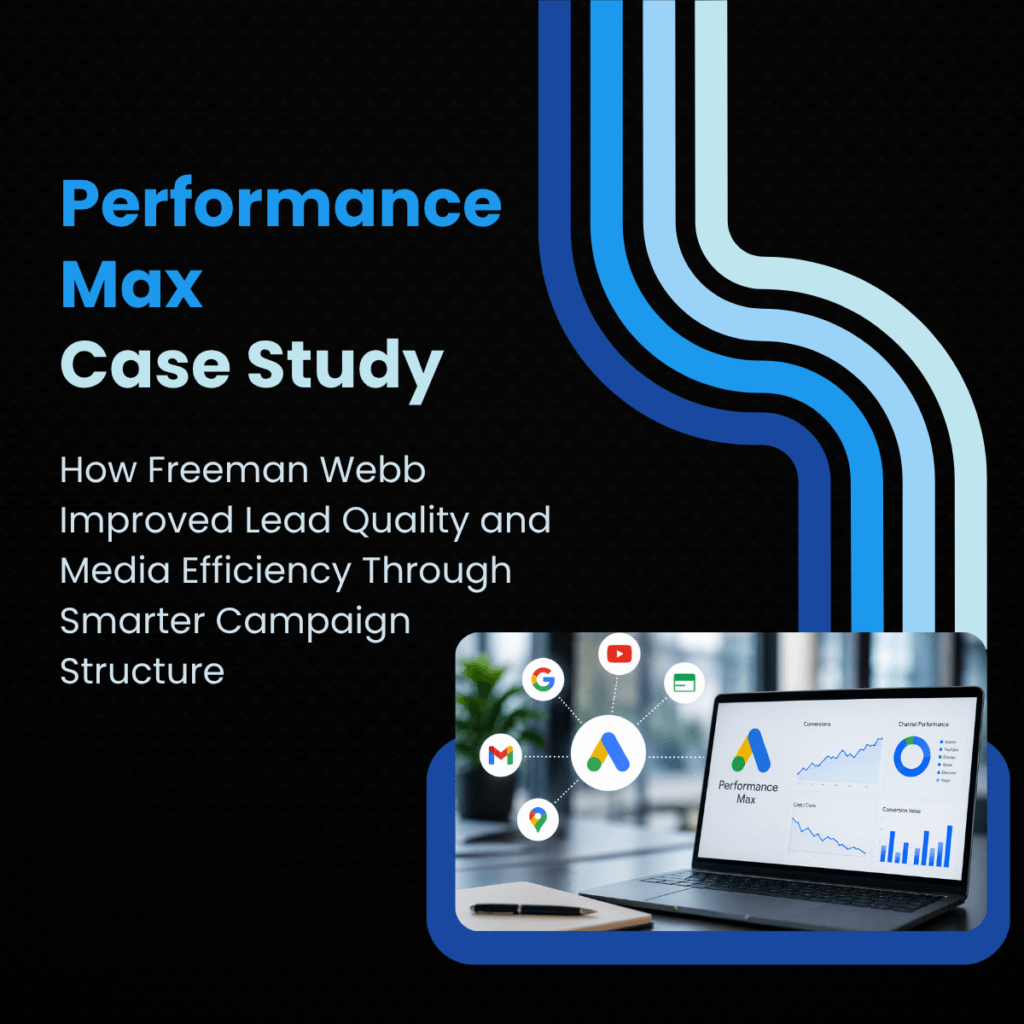
How Freeman Webb Improved Lead Quality and Media Efficiency Through Smarter Campaign Structure
Performance Max has become one of the most debated campaign types in multifamily marketing.
Some marketers see it as a powerful acquisition channel. Others see it as a black box that cannibalizes branded search traffic, weakens lead quality, and introduces unnecessary inefficiency into the media mix.
In reality, the issue is usually not the platform itself. It is the strategy guiding it.
Poorly structured campaigns often blur the line between prospecting and branded intent, compete against high-performing paid search campaigns, and expand targeting too broadly to consistently attract high-intent renters.
As a result, many multifamily teams walk away from Performance Max believing it lacks control, when the real challenge is how the campaigns are built and managed.
At the same time, the platform has evolved quickly. New capabilities around geo-targeting, brand exclusions, traffic quality controls, and asset testing are giving marketers far more influence over campaign behavior than they had even a year ago.
The difference now is not whether you use Performance Max. It is whether you are using it strategically.
The Multifamily Marketing Challenge Freeman Webb Needed to Solve
Freeman Webb partnered with Digible to solve a challenge many multifamily advertisers are facing today: how to make Performance Max function as a true acquisition channel without competing against the rest of the media strategy.
The initial issues were familiar. Campaigns were overlapping with branded paid search traffic, geographic targeting was too broad to consistently attract qualified renters, and low-quality placements were reducing overall traffic efficiency.
Instead of treating these as unavoidable limitations of the platform, the strategy focused on tightening control and redefining the role Performance Max should play within the broader acquisition ecosystem.
How Digible Optimized Performance Max Campaigns for Better Lead Quality
Digible implemented a focused optimization strategy using the latest Performance Max capabilities.
Smarter Geo-Targeting for Higher-Intent Renters
Geo-targeting was refined to prioritize renters physically located within a five-mile radius of each property, while interest-based location signals were removed to better align campaigns with active in-market behavior.
Traffic Quality Controls and Brand Exclusions
Traffic quality controls and validated blocklists were implemented to reduce exposure to bot-heavy and low-intent inventory.
Brand exclusions were also introduced to prevent Performance Max from competing against branded search campaigns that were already performing efficiently.
Continuous Performance Max Testing and Optimization
Most importantly, the campaigns were actively managed.
Continuous testing across asset groups, creative variations, and floorplan-focused messaging transformed Performance Max from a passive automation tool into a strategically optimized prospecting channel.
Performance Max Results: Improved Efficiency and Stronger Paid Search Performance
The impact extended beyond Performance Max itself.
We analyzed performance across the three months before and after implementing the new strategy (February 1 – April 30, 2025 vs. May 1 – July 31, 2025).
Performance Max Results
- Click-through rate (CTR) increased by 15%
- Cost per click (CPC) decreased by 16% to an average of $0.93
- Site acquisitions increased by 11%
- Cost per acquisition (CPA) improved by 8% to an average of $23.17
Branded Paid Search Results
- Cost per acquisition (CPA) decreased by 14% to an average of $4.75
- Conversions increased by 21%
Why Paid Search and Performance Max Work Better Together
The results reinforced a larger shift happening across multifamily marketing strategy.
Search campaigns are designed to capture existing demand. Performance Max helps create and expand that demand across channels like YouTube, Gmail, Display, and Maps.
The mistake is treating the two channels as competitors instead of building a strategy where both serve distinct and complementary roles.
When aligned correctly:
- Performance Max drives incremental, high-quality leads
- Paid Search becomes more efficient without internal competition
- The overall media strategy becomes more scalable and cost-effective
The goal is not to choose between Search and Performance Max.
The goal is to build a strategy where both channels work together to strengthen overall performance.
Final Thoughts on Building a Smarter Performance Max Strategy
As Performance Max continues to evolve, so do the strategies required to maximize its impact.
The difference between average and high-performing campaigns often comes down to how intentionally they are guided: controlling where traffic comes from, separating brand from prospecting, aligning targeting with real renter intent, and continuously optimizing as capabilities evolve.
Freeman Webb’s results reinforce a simple truth:
Performance Max is most effective when it is intentionally built to complement your broader strategy, not compete with it.
Performance Max is no longer experimental. The question is whether your strategy is evolving with it.
If you’re evaluating how Performance Max should fit into your broader multifamily acquisition strategy, Digible can help identify where efficiency is being lost and where opportunity still exists.